


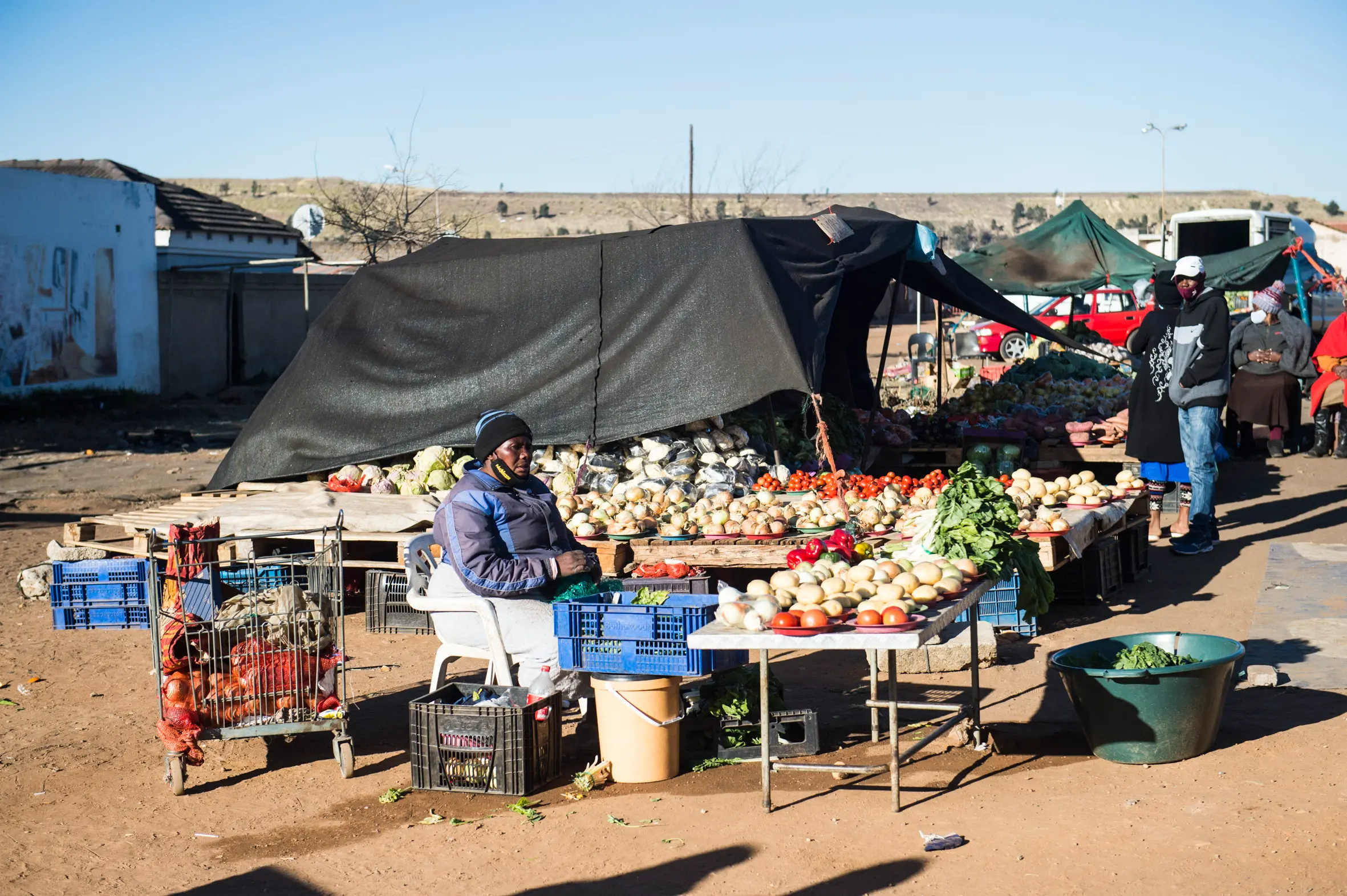
The people who feed Africa's cities have almost no say in how food is governed. Consider a woman selling tomatoes and onions at a taxi rank in Khayelitsha, a spaza shop owner giving families credit at the end of the month, a vendor cooking pap and stew for builders on a Johannesburg pavement.
People like these supply most of the food that poor urban households eat. Yet they are rarely in the room when governments, donors and international agencies decide what food policy should do.
This is not an oversight. Food governance now justifies itself by claiming to include everyone, through summits, councils, platforms and multistakeholder partnerships. In a recent paper, we call it the governance of absence. In practice it is organised in ways that keep out the people who do most of the work of feeding the continent. Their problems drop out of view as well because they are absent.
Around 85% of Africa's food system runs through micro, small and medium enterprises, most of them informal. More than four in five African workers are informally employed, and the share is higher for women than for men. Africa's urban population is expected to double between 2020 and 2050, to 1.4 billion. For most of those people, informal traders will remain the main source of food.
South Africa is about to test whether this can change. Government is consulting the provinces on its second National Food and Nutrition Security Plan, which will run for 10 years. The first plan did not work. An evaluation in 2023, found that only 11 of its 65 targets were met, the national council meant to oversee it never met and it had no budget of its own. In other words, there was no political commitment.

Why they are left out
On Africa Day for Food and Nutrition Security (30 October), we highlight three things that keep the people who feed the poor out of food governance.
The first is an old idea that still decides where the money goes. In the 1970s economist Michael Lipton argued that development policy favoured cities over the countryside. That no longer describes African urbanisation, where most urban growth now comes from people born in cities rather than rural migrants. Yet the large funders, among them the Gates Foundation, Alliance for a Green Revolution in Africa, the Food and Agriculture Organisation of the United Nations and the International Fund for Agricultural Development treat hunger mainly as a problem of growing more food on farms.
The second is the assumption that if enough food exists, people can get it. Tonnes harvested are easy to count. They say nothing about whether a family in Mitchells Plain can afford vegetables at the end of the month. The Western Cape's results in the National Food and Nutrition Security Survey show where this leads. The survey found that roughly the same share of households went hungry on farms as in towns and cities, about 47% and 45%.
On that basis, the report called for urgent action in rural areas. But 95% of the province's 7.3 million people live in towns and cities. In numbers, that means about three million hungry people in urban areas and about 170 000 in rural ones, a gap of nearly 18 to one. Because the report compared percentages and assumed that hunger is a rural problem, it pointed policy away from most of the people going hungry.
The third is that the rules for taking part assume everyone belongs to a formal organisation. Donor programmes require logframes and audited accounts. Consultations add to the problem. A meeting in a government venue, during working hours, mainly in English, is open in principle and closed in practice to a trader who would lose a day's sales by attending. The provincial hearings on South Africa's new plan, organised by premiers' offices with invitations at their discretion, risk working in exactly this way.
The people in between
Facilitator organisations step into this gap, promising to convene stakeholders and amplify the voices of the marginalised. However, they depend on donor money tied to measurable results and on good relations with officials, so they answer to funders and to government. The communities they speak for have no way of holding them to account.
At global level the picture is starker. A study of 45 multistakeholder initiatives in the food system found that executives from the ultra-processed food industry or groups linked to it held 43.8% of their board seats. A 10-year evaluation of forty such initiatives concluded that they do not work as tools for holding corporations to account. Treating a multinational food company and a street vendors’ association as equal “stakeholders” hides the gap in power between them. People who go hungry are not stakeholders. They are rights-holders and the state owes them a duty.

How hunger becomes normal
The result is that hunger comes to be accepted as normal. Hungry people rarely organise politically, because getting through each day takes their time and energy and past protest has often brought repression rather than food. The historian John Bohstedt observed that if hunger and anger were enough to cause food riots, world history would consist mostly of food riots. The absence of protest does not mean people are fed.
Three shifts
Changing this needs the people who feed poor households to be recognised as part of governing food, not treated as a problem to be cleared off pavements or pushed into formality. Trader associations organise their members and are respected by them. They should sit on the municipal committees that decide on markets, land use and infrastructure. South Africa's draft plan proposes local food system forums. If they are chaired by civil society and funded so that traders and community organisations can take part for years, they could be where this starts.
Accountability should also run to the people affected and it should have consequences. Social audits, community scorecards and public reporting in local languages are useful only if officials must act on what they show. Jonathan Fox, who has studied accountability programmes worldwide, calls this giving accountability teeth. Ubuntu offers a better basis than the complaints procedures and satisfaction surveys now in use, because it treats accountability as a continuing relationship of mutual obligation between leaders and communities. South Africa's draft plan treats monitoring mainly as government reporting upwards.
We should also stop pretending that food policy can be made by consensus. Farmers want high prices and consumers want low ones. What suits supermarket chains can harm informal traders. Processes built around "shared goals" usually settle these conflicts in favour of the most powerful, and then claim everyone agreed. Adam Kahane, who has facilitated dialogue in some of the world's most divided settings, argues that people can work together without first agreeing. Disagreements should be brought into the open, so that traders can challenge municipal policy and communities can challenge donor priorities directly. That will be uncomfortable but it is better than meetings that change nothing.
None of this is a technical fix. It means moving voice, money and decision-making power to people who now have little of any of them. The institutions that run food governance will resist, because donor funding, habit and the interests of those who benefit keep them as they are. Without that shift, food governance will keep reporting progress on its own indicators while the people it claims to serve go hungry.
Professor Scott Drimie is co-director of the Southern Africa Food Laboratory in the Faculty of AgriSciences at Stellenbosch University. Dr Gareth Haysom is the Urban Food Systems Cluster lead at the African Centre for Cities at the University of Cape Town.